

Current editionIndependent · Evidence led · Published in AustraliaSpecial Tribute Edition · 30 October 2026

The weekly paper
for curious people

See the connections.
Understand the consequences.

Free email via Substack →

Swipe to see more sections →

Tribute · Issue 012 Special Tribute · New York & Los Angeles, United States

Cowboy songs for refugees and a quiet chair for a rescue dog

Why a classical Shakespearean actor recorded a five-track album of Western ballads for the International Rescue Committee—and how fostering a pit bull named Ginger challenged stereotypes around rescue dogs.

Listen to this story

Listen to the article text

Hear this story in your device’s voice.

Sir Patrick Stewart smiling warmly at the Toronto International Film Festival in September 2015
Sir Patrick Stewart photographed by NASA’s Bill Ingalls in September 2015, shortly before recording Patrick Stewart’s Cowboy Classics for the International Rescue Committee and fostering rescue pit bull Ginger with the ASPCA.Photo: Bill Ingalls / NASA (Wikimedia Commons) · Public Domain (NASA)

In July 2016, Sir Patrick Stewart appeared in a white Stetson hat and suede fringe jacket as “Cowboy Pat” to release Patrick Stewart’s Cowboy Classics, a five-track CD of Western songs including “Rawhide”, “Buttons and Bows” and “Don’t Fence Me In”. The joke was deadpan, the Yorkshire diction was unmistakable, and every cent of the proceeds went to the International Rescue Committee (IRC). [IRC1] [IRC2]

Behind that light-hearted recording sat more than a decade of serious humanitarian work. As an IRC Ambassador, Stewart supported emergency relief and resettlement programmes for families displaced by conflict, spoke at the IRC’s Freedom Award benefit, received the International Press Academy’s Humanitarian Award in December 2016, and joined a 2023 public appeal urging governments and citizens to show compassion toward refugees. [IRC1] [IRC2] [UNA1]

Ginger, Wags and Walks, and the ASPCA

A few months after Cowboy Classics, in March 2017, Stewart and his wife Sunny Ozell partnered with the ASPCA and the Los Angeles rescue group Wags and Walks to foster their first pit bull, Ginger. Having grown up in England where his mother was afraid of dogs, Stewart had never owned a dog as an adult. Within hours of Ginger arriving at their Los Angeles home, he was posting videos of himself sitting on the floor beside the swimming pool, softly singing to her while she licked his face. [ASP1] [PS4]

Those videos reached tens of millions of viewers. Stewart used the attention to campaign against dogfighting through the ASPCA’s National Dog Fighting Awareness Day (#GetTough), fostered further rescue dogs, and asked the producers of Star Trek: Picard to give Admiral Picard a rescue pit bull named Number One. In November 2021, the ASPCA awarded him its Pit Bull Advocate & Protector Award. [ASP1]
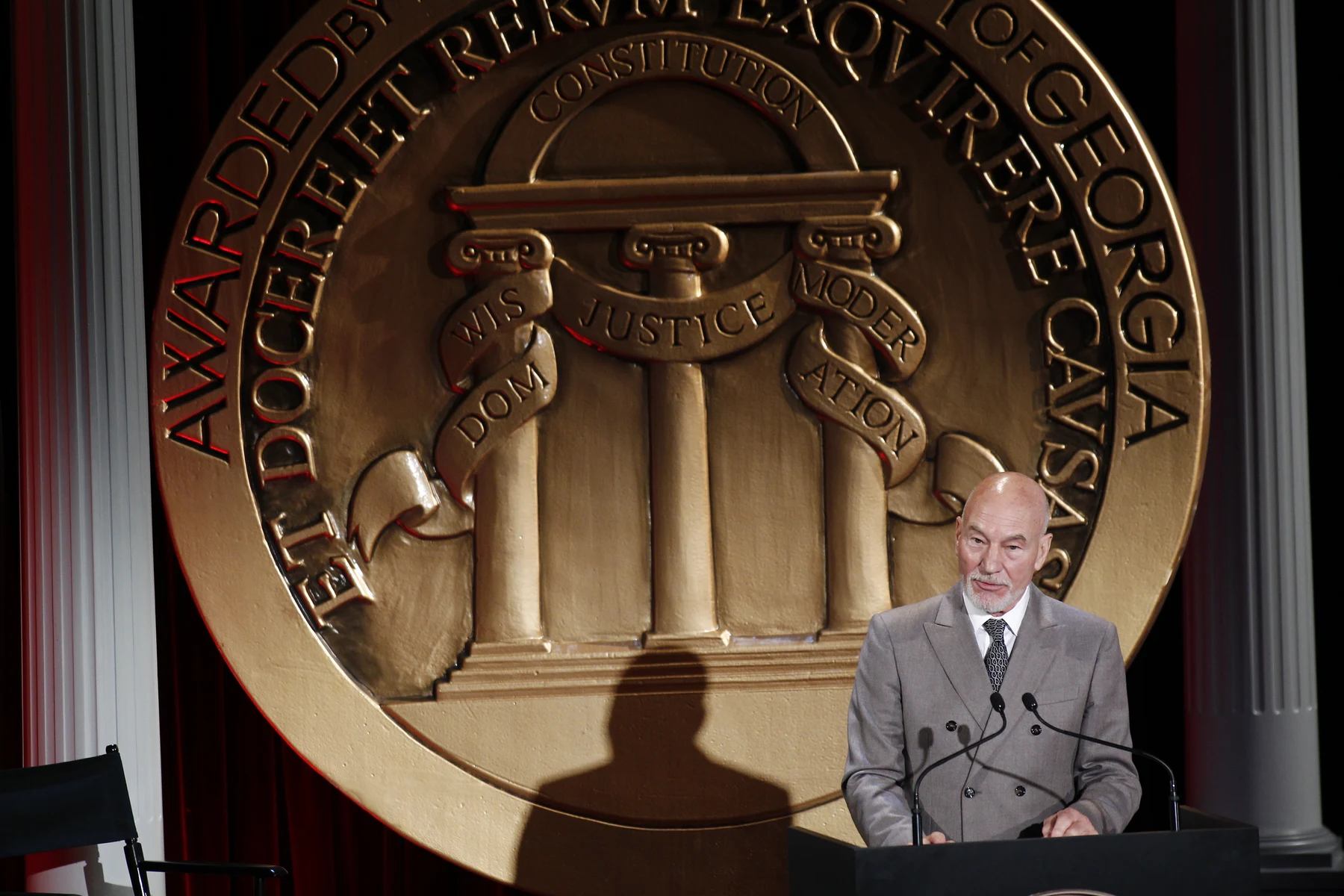
Sir Patrick Stewart speaking at the podium in front of the golden Peabody Awards medallion inscribed Wisdom, Justice, Moderation
Sir Patrick Stewart speaking at the Peabody Awards in New York.Photo: Peabody Awards (Wikimedia Commons) · CC BY 2.0

An idea to try

Foster, or help the people who do

Local animal shelters and rescue groups rely on short-term foster carers to give dogs a calm home environment while they wait for permanent adoption. Even a few weeks of fostering frees up space in a shelter and helps staff understand a dog’s temperament.

If you cannot foster an animal at home, shelters and local refugee community-sponsorship groups almost always publish lists of practical items, transport rosters and fundraising needs where a small contribution helps immediately.

What this could change

The ASPCA credited Stewart’s foster videos and anti-dogfighting campaigns with helping challenge public prejudice against pit bulls, which remain among the most frequently sheltered and euthanised dogs in the United States while breed-specific restrictions continue in the UK. Similarly, the International Rescue Committee continues to rely on public donations as global displacement reaches historic highs. While viral videos cannot by themselves rewrite breed laws or asylum policies, local shelter adoption rates and humanitarian funding appeals show where public goodwill turns into lasting protection. [ASP1] [IRC1] [IRC2]

Sources

Lens did not conduct original interviews for this commemorative edition. Every story, quotation and connection in the Stewart Constellation draws on the published interviews, memoirs, academic repositories, parliamentary records and organisational accounts linked below each article.

Photo: Bill Ingalls / NASA (Wikimedia Commons) · Public Domain (NASA).

Free Lens updates

A new perspective, when the next Lens is ready.

Our free weekly email brings you the latest reporting, the questions still open and any meaningful changes.

Send me the free Lens email →
Delivered by Substack. Entering your email creates a private Substack account. No app or public profile needed. Unsubscribe anytime.
Open the signup page instead →