
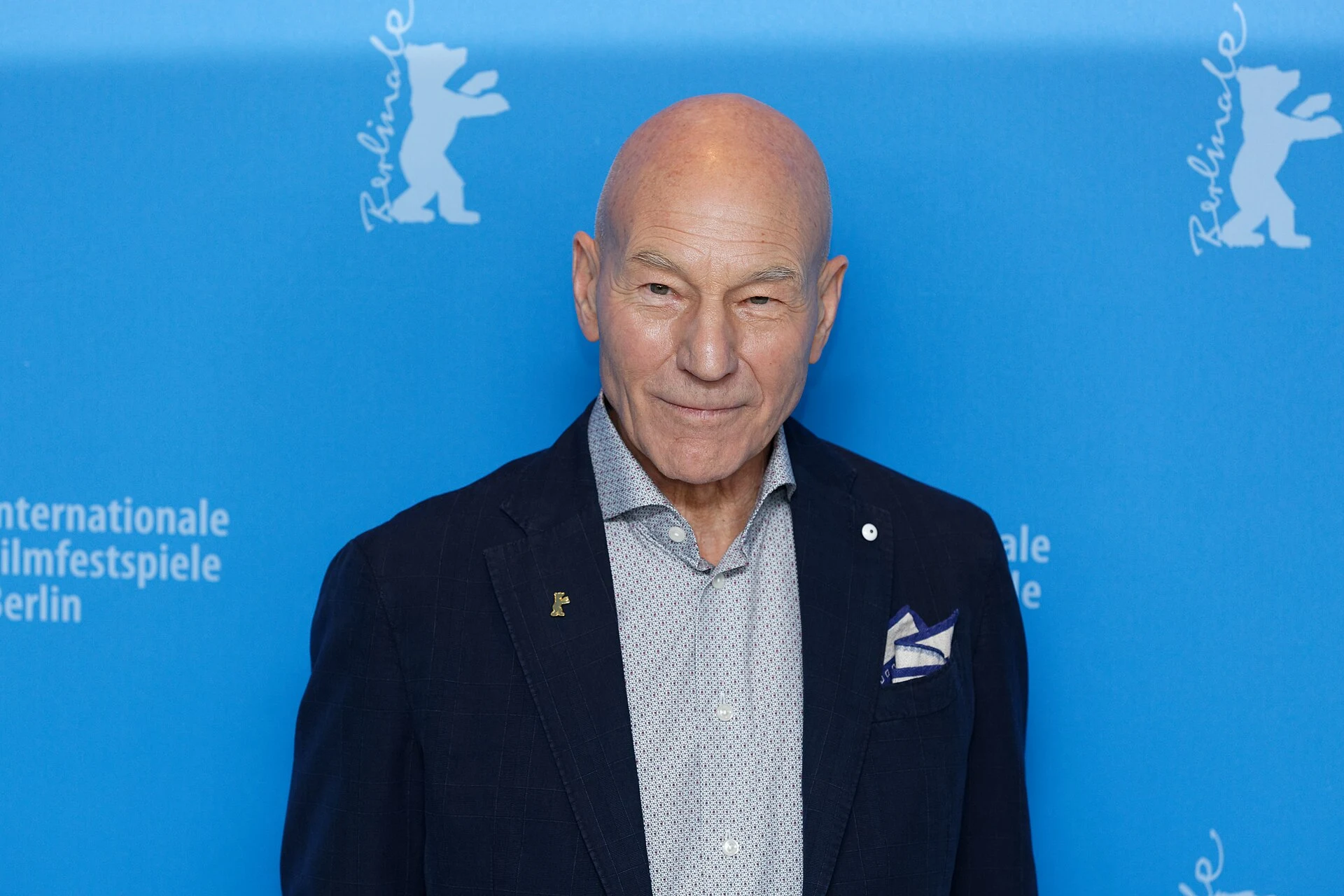
In February 1989, midway through the second season of Star Trek: The Next Generation, Patrick Stewart walked into a television courtroom for an episode written by former lawyer Melinda M. Snodgrass called “The Measure of a Man”. A Starfleet cyberneticist wanted to dismantle Lieutenant Commander Data to learn how he had been built. Captain Jean-Luc Picard had to argue that his friend was a person rather than property. [ST1] [PS4]
Speaking quietly to the judge, Picard warned that the ruling would reach far beyond one android: “It will reveal the kind of a people we are, what he is destined to be.” Pointing toward Data’s chair, he ended simply: “Your Honour, Starfleet was founded to seek out new life. Well, there it sits. Waiting.” [ST1]
When Sir Patrick Stewart died at his home in Los Angeles on 28 October 2026 at the age of 86—surrounded by his wife Sunny Ozell, family and friends after living with Alzheimer’s disease and Lewy body dementia—that courtroom speech was one of the first moments people shared across the world. For seven seasons on The Next Generation, four feature films and three seasons of Star Trek: Picard, alongside seventeen years playing Professor Charles Xavier in the X-Men films through Logan in 2017, he gave popular science fiction the stillness and moral weight of classical theatre. [PS1] [PS2] [PS3]
From Mirfield to Stratford-upon-Avon
Nothing about his early life in Mirfield, in the West Riding of Yorkshire, made that career inevitable. Born on 13 July 1940 in a tiny terrace house with an outside privy, Stewart grew up in a household marked by poverty and by the violence his father Alfred inflicted on his mother Gladys after returning from the Second World War. [PS2] [RF1] [CS1]
As he later wrote in The Guardian and in his 2023 memoir Making It So, the theatre became the one place where he was safe—first because a teacher named Cecil Dormand handed him a copy of The Merchant of Venice at age twelve, and then because a West Riding County Council scholarship enabled him to study at the Bristol Old Vic Theatre School in 1957. [CD1] [PS5]
Joining the Royal Shakespeare Company as an associate artist in 1966, Stewart spent more than sixteen years playing over sixty roles—from Enobarbus in Peter Brook’s production of Antony and Cleopatra to Oberon in A Midsummer Night’s Dream, and later Macbeth, King Lear, Prospero, and Claudius opposite David Tennant’s Hamlet in 2008. When he arrived in Los Angeles in 1987 to play Jean-Luc Picard, he kept his bags half-packed for weeks, convinced an English Shakespearean actor in a bald head and Lycra jumpsuit would be sent home before Christmas. [PS2] [PS4] [PS5]
A life that kept reaching outward
What makes Patrick Stewart’s life so revealing to trace in Lens is what he chose to do with the platform those roles gave him. Rather than lending his name indiscriminately, he returned again and again to the fault lines of his own life. [RF1] [CS1] [HUD1]
For his mother Gladys, he became a patron and ambassador for Refuge and spoke for Amnesty International UK, challenging the excuse that domestic violence is ever a private family quarrel. For his father Alfred—whose untreated wartime shell shock from Dunkirk Stewart only uncovered while filming Who Do You Think You Are? in 2012—he became a patron of Combat Stress to support veterans living with psychological injury. [RF1] [CS1] [CS2]
For students in his home region, he served for eleven years as Chancellor of the University of Huddersfield, where he and Refuge established a funded PhD scholarship in his name that appointed researcher Julia Brooke to study relationship abuse affecting pregnant teenagers and young mothers. And beyond Yorkshire, he spent more than a decade as an ambassador for the International Rescue Committee—even recording a five-track album of country songs, Patrick Stewart’s Cowboy Classics, to raise funds for displaced families—while fostering rescue pit bulls in Los Angeles with Sunny Ozell and reading all 154 of Shakespeare’s sonnets online during the 2020 pandemic lockdowns. [HUD1] [HUD2] [IRC1] [IRC2] [ASP1] [SN1]
Not every association in a public life carries the same kind of evidence. Some records establish funded academic research or hands-on participation; others record public advocacy for organisations such as Humanists UK, the United Nations Association–UK, or Dignity in Dying, where assisted dying remains a contested question before the UK Parliament. In the Stewart Constellation and the six companion reports that follow, we trace each connection on its own evidence. [HUD1] [HUM1] [UNA1] [DID1] [DID3]