Issue 002 · Story 3 · PrivacyOne story. Many lenses.
Same evidence. Different perspective.
Viewing through
Whole story
Start with the shortest supported answer, then follow the evidence and the limits together.
What comes into focusIt keeps the claim, its source and the point where certainty ends in one view.
What this view may missA specialist Lens can make one practical consequence easier to see.
Changing the Lens changes what comes into focus. It never changes the evidence underneath.
Issue 002 Story 3 · Privacy
You submitted the 2026 Census. Where do your name and address go now?
Your identity fields are used during processing, then separated from the other answers. Separation is a protection—but it is not the same as immediate destruction.
By Lens with Sense EnginePublished 16 August 2026About six minutes
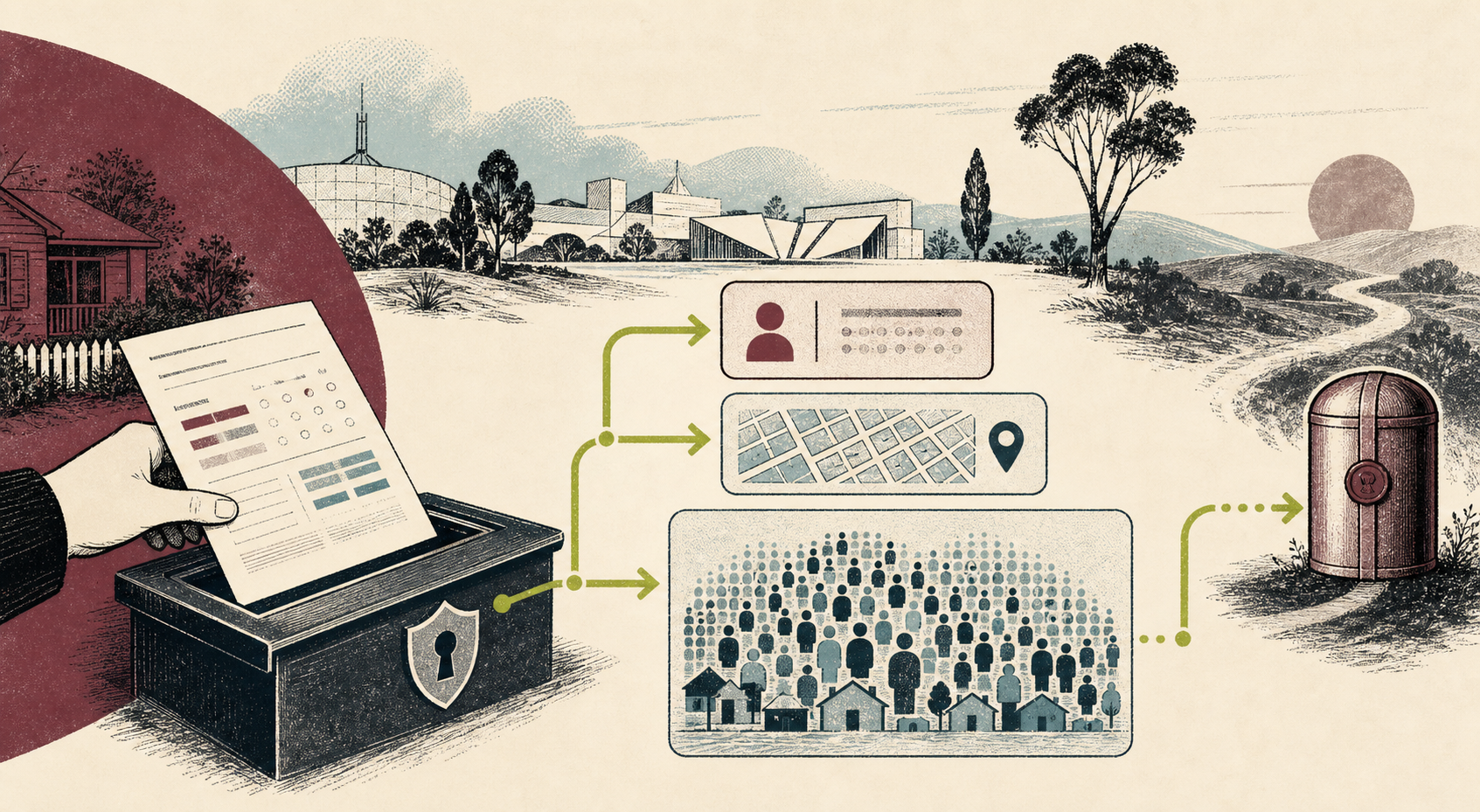
The form does not follow one path: identity, location, statistical answers and the optional archive are handled differently. Original AI-assisted Lens illustration.
Watch the relevant chapter from Lens in 8, then inspect the evidence below.
What people heard
Once the Census is processed, my name and address either disappear immediately or stay attached to everything forever.
Established, with an important distinction
What actually happens to the identity records?
Short answer. The ABS uses identity fields during processing, then separates names and addresses from other answers and keeps them under different retention limits.
Choose how to read this
Read, listen or follow the question.
The facts do not change. Each view uses the same published sources and leaves the same questions open.
◫Different viewsSee what each perspective notices—and may miss.
See through another Lens
Which view do you want to understand first?
Each view notices something useful. None is allowed to stand in for the complete evidence.
Household
I need to know whether information identifying me is disclosed or used against me.
What this view explainsWhy secrecy, separation, access controls and disclosure boundaries matter.
What it may missA public policy cannot reveal the live state of one submitted form.
The answer
The ABS separates the records after processing, then keeps names and addresses for different maximum periods.
01
Process
Names help with household completion, duplicates, quality review and approved data linkage. Addresses support geographic statistics and population estimates.
02
Separate
The ABS says it removes names and addresses from other Census data during processing, then stores the separated records apart.
03
Retain, then destroy
Names may be kept to February 2028 and addresses to August 2029 under the stated maximum periods.
The public notices describe policy and maximum periods. They do not expose live household-level processing events.
01
Submitted form
The form contains identity, location and household answers. Once submitted, the ABS says the form itself cannot be accessed or changed by the respondent.
02
Statistical processing
Identity fields support duplicate detection, quality work and linkage. Encryption, access controls, audit logging and secrecy duties apply.
03
Separated storage
Names and addresses are removed from other Census answers and stored separately from those answers and from one another.
04
Destruction limits
The stated maximum is 18 months for names and 36 months for addresses. Other records follow separate archives authorities.
What “separated” does not mean
It does not mean every record became anonymous the moment Submit was pressed. It also does not mean de-identified data can never be linked for approved research.
The time capsule is preservation, not ordinary retention.
If the household chose the 99-year time capsule, the Census information is transferred to the National Archives of Australia. Once transferred, the choice cannot be reversed and the information cannot be accessed, altered or retrieved before 2125.
The ABS says administrative data used to support Census processing is not included in that transfer. The public records do not establish whether one household selected the option or whether its transfer has already occurred.
Identifiable disclosure and statistical use are different questions.
A privacy explanation becomes misleading when every form of use is collapsed into “shared” or “not shared.”
Identifiable form information
Not shared for ordinary government enforcement or marketing
The ABS says it does not share Census-form information that could identify a household with other departments or direct-marketing companies, and does not use it for compliance or enforcement apart from Census Act offences.
De-identified statistical information
Can support research and limited approved sharing
The ABS may link de-identified Census data with other datasets under strict controls. DATA Scheme sharing is limited to permitted purposes and requires written approval from the Australian Statistician.
A public privacy statement cannot show the live state of your form.
The current processing stage of a particular household's form
The exact deletion date for one name or address within the stated maximum period
Whether one household selected the optional time capsule
Whether an elected archive transfer has already occurred
Which future approved research projects will use de-identified Census data
Show me the evidence
Two ABS records define this path.
The Privacy Statement explains handling and use. The Collection Notice explains what was collected, why and the principal retention limits.
Established
The ABS says names support household completion, duplicate processing, quality review and data linkage; addresses support geographic statistics, population estimates, travel-to-work analysis and the Address Register.
During processing the ABS removes names and addresses from other Census form data; once processing is complete, names and addresses are stored separately from other Census data and separately from one another.
The ABS says it does not share identifiable Census-form information with other government departments or direct-marketing companies and does not use Census information for compliance or enforcement, apart from Census Act offences.
The ABS may integrate de-identified Census data with other datasets for research under governance controls and may share Census information for limited permitted purposes under the DATA Scheme with written approval from the Australian Statistician.
If selected, Census information is transferred to the National Archives for 99 years, cannot be accessed for any purpose until 2125 and cannot be reversed after transfer; supporting administrative data is not included.
ABS 2026 Census Privacy Statement and Collection Notice
The ABS says a person cannot access or change information on a submitted Census form, although other Census-operation contact records have separate access and correction processes.
The admitted public records cannot establish whether one household's names have already been separated, the exact destruction day within the stated limits or whether an elected time-capsule transfer has occurred.
Lens assessment
Lens assessment
How we checked it Read the reporting notes
The question
Understand the post-submission path of identity fields, statistical answers and the optional time capsule without confusing separation, destruction and archival preservation.
What we checked
The ABS 2026 Census Privacy Statement and Data Collection Notice available through 16 August 2026. Internal processing logs, an individual's submitted form and the eventual operation of the archive transfer are outside the established boundary.
Best-supported answer
The ABS uses names and addresses during Census processing, then removes them from the other form data and stores names and addresses separately. Names may be retained until the end of February 2028 and addresses until the end of August 2029 before destruction under records authorities. If the household chose the time capsule, the submitted Census information is transferred to the National Archives, cannot be retrieved or changed and remains closed until 2125.
Why we told it this way
The evidence supports a branching data-path explanation with distinct processing, separation, retention and optional archive stages. It does not support a claim about the processing state of one submitted form.
An editor remains responsible. Sense separated processing, identity storage, statistical use, destruction limits and optional archival preservation. Lens remains responsible for the wording, source admission and corrections.
Issue 002 record Two current ABS primary records reviewed · Sense run opened before prose · processing, separation, destruction and optional archive kept distinct · original illustration labelled · published 16 August 2026
Possible effects · We cannot say how likely
What this could change
The published path creates dated tests for separation, destruction and optional archiving. It could make later privacy claims more auditable, but public notices cannot reveal the live state of one household's record.
Documented action
The ABS published distinct purposes, separation steps and maximum retention periods for names, addresses, statistical data and the optional time capsule.
What Lens thinks may follow
Those commitments could give oversight bodies and the public clearer checkpoints for testing whether identity fields are separated, destroyed or archived as described.
Where the connection stopsThe notices establish the declared handling rules, not a live audit of systems or the processing state of an individual form.
What this depends on—and other possibilities
This depends on
Later assurance work reports against the same categories and maximum periods.
Any change in handling is documented clearly enough for comparison.
Other explanations
Compliance may be demonstrated through non-public controls rather than household-level status reports.
A policy description can remain accurate while implementation problems occur in isolated cases.
How different interpretations could affect what happens next
How people may respond
How the story itself could change what happens
How people understand the separation, destruction and optional archive pathways could influence trust in Census handling and future participation.
What the evidence does not showThe published process is established; its effect on trust, consent or response behaviour is not measured here.
One possible path
The process is interpreted as inspectable stewardship
Not enough evidence yet
How it is told
The story separates processing, identity handling, destruction and optional archive decisions.
What people may take from it
Clear, verifiable stages may make the privacy promise easier to assess than one general assurance.
Where attention could turn
Attention shifts toward whether each published commitment is later completed.
What people may do
ABS, archivists and participants: Provide or seek evidence that the promised stages occurred.
What could change
Trust becomes more dependent on observable compliance and correction.
What we know has changedWe have not established that this possible change has happened.
What this does not showVerification of process would not show that every participant feels reassured.
Why we are cautious
Why we cannot tell yet
This is the first time Lens has mapped this path. We have no later evidence showing whether it is happening more, less or about the same.
Signs that would support this path
An audit or assurance report addresses the 2026 identity-retention and separation controls.
Signs that would weaken it
The report does not test the relevant controls or periods.
Definitions change so the reported categories are not comparable.
This depends on
Later assurance work reports against the same categories and maximum periods.
Any change in handling is documented clearly enough for comparison.
One possible path
A later change reframes the privacy bargain
Not enough evidence yet
How it is told
The current pathway is presented as a set of distinct commitments.
What people may take from it
A changed retention, linkage or archive rule could be interpreted as altering the terms under which information was supplied.
Where attention could turn
Public and institutional attention could move from procedure to consent and accountability.
What people may do
ABS, government and participants: Explain, challenge or revise the handling arrangement.
What could change
A policy change could commit the system to a materially different data path.
What we know has changedWe have not established that this possible change has happened.
What this does not showConcern about a hypothetical change is not evidence that one has occurred.
Why we are cautious
Why we cannot tell yet
This is the first time Lens has mapped this path. We have no later evidence showing whether it is happening more, less or about the same.
Signs that would support this path
A revised notice, reportable incident or formal change to retention or sharing authority.
Signs that would weaken it
The change concerns unrelated administrative records.
The existing handling path and maximum periods remain unchanged.
This depends on
Later assurance work reports against the same categories and maximum periods.
Any change in handling is documented clearly enough for comparison.
Two ways this could develop
This depends on what happens next
The published commitments are independently verified
If assurance or oversight reports test separation, access controls and destruction against the stated dates
Then the public could distinguish verified implementation from a policy promise and identify any material exception.
What to watch—and what would weaken it
An audit or assurance report addresses the 2026 identity-retention and separation controls.ABS assurance publications, parliamentary oversight and privacy-regulator reports.
Would weaken this: The report does not test the relevant controls or periods. Definitions change so the reported categories are not comparable.
Scope: 2026 Census identity-field handling and the optional archive path. Horizon: Through the February 2028 name and August 2029 address limits.
This depends on what happens next
A later change requires a new privacy explanation
If law, policy, system design or an incident materially changes how identity or de-identified data is handled
Then the current explanation could need revision and readers would need a new account of purpose, access, retention and remedy.
What to watch—and what would weaken it
A revised notice, reportable incident or formal change to retention or sharing authority.ABS notices, OAIC records, legislation and National Archives authorities.
Would weaken this: The change concerns unrelated administrative records. The existing handling path and maximum periods remain unchanged.
Scope: Material changes to the described 2026 Census path, not speculation about undisclosed access. Horizon: Until the relevant identity-retention periods end and any time-capsule transfer is complete.
How do we know?Inspect the evidence and its limits
Evidence used in this assessment
ABS 2026 Census Privacy Statement · date unknown2026 Census Privacy Statement
The ABS says names support household completion, duplicate processing, quality review and data linkage; addresses support geographic statistics, population estimates, travel-to-work analysis and the Address Register.
Open evidence ↗ABS 2026 Census Privacy Statement and Collection Notice · date unknown2026 Census Collection Notice
Census form names are retained for up to 18 months, to the end of February 2028, and addresses for up to 36 months, to the end of August 2029.