Reader
I need to know the next step and what it might cost.
What this view explainsWhy a free scan still starts with a conversation and a referral.
What it may missGeneral information cannot settle individual suitability.
The weekly paper
for curious people

See the connections.
Understand the consequences.
Swipe to see more sections →
Health Lens · Before symptoms
The scan is one step. The useful part is knowing how to enter the pathway—and what happens after the picture.
Targeted screening; a clinical pathway
Australia’s lung screening program targets people aged 50–70 without symptoms suggesting lung cancer, with at least 30 pack-years of cigarette smoking, who currently smoke or quit within the past 10 years. A healthcare provider checks eligibility and suitability and supplies the scan request. The program scan is free; a consultation may cost. Symptoms need medical assessment, not a wait for screening.
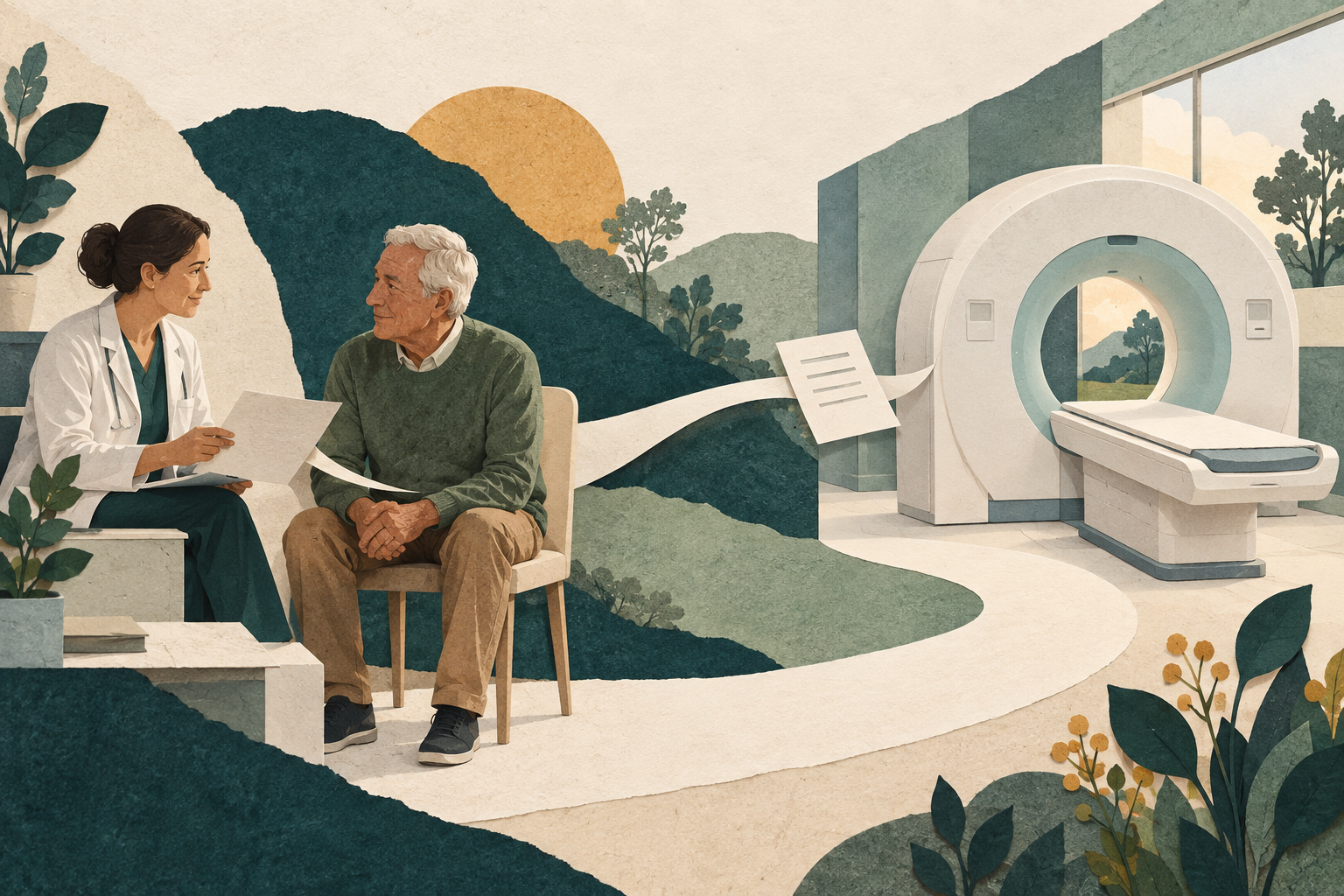
Watch through Lens · Issue 006 · 8:37
Start with lung screening at 6:19, then follow the rest of the episode. The reporting and sources stay on this page.
An illustrative question: “There is a free lung scan—can I just book one?” This is not a measured claim about public beliefs.
Choose how to read this
The facts do not change. Each view uses the same published sources and leaves the same questions open.
See through another Lens
Each view notices something useful. None is allowed to stand in for the complete evidence.
Reader
I need to know the next step and what it might cost.
What this view explainsWhy a free scan still starts with a conversation and a referral.
What it may missGeneral information cannot settle individual suitability.
The national program began on 1 July 2025. It looks for lung cancer before symptoms in a defined group at higher risk. You do not need to wait until you feel ill; you also do not have to quit smoking before you can participate.
For entry, the criteria work together: age 50–70, no symptoms suggesting lung cancer, current cigarette smoking or quitting within 10 years, and at least 30 pack-years. A clinician also checks whether the scan is suitable. Age alone does not settle it.
Read the source →Read the source →One unit, two dimensions
Using 20 cigarettes as one pack, multiply average packs per day by years smoked. These are arithmetic examples, not eligibility decisions.
1 pack/day × 30 years
= 30 pack-years2 packs/day × 15 years
= 30 pack-years½ pack/day × 60 years
= 30 pack-yearsReal histories change. A healthcare provider can help estimate the periods rather than pretending every year was identical. The total does not diagnose disease or measure your personal chance of cancer.
Read the source →Once smoking-history eligibility is established, it does not have to be reassessed. Passing ten years since quitting does not automatically remove an existing participant. People can continue until they turn 71, unless findings mean they leave screening for another care pathway. Suitability is still checked.
Read the source →Read the source →Follow the next step
Check eligibility, suitability, benefits and harms with a healthcare provider.
Use the request for a low-dose CT at a participating imaging service.
Discuss findings and complete the recommended next step.
The program scan is bulk billed. The referring consultation may have a fee; check when booking. Travel, further investigations and other care can bring separate costs.
Read the source →Read the source →Most lung nodules are not cancer. Some reflect old scarring. Their appearance and change over time can guide what happens next. Being asked back is therefore neither a diagnosis nor a reason to ignore follow-up.
Read the source →Usually another screen in two years while eligible and suitable.
The result may call for another scan in 3, 6 or 12 months.
A specialist may need other tests. Screening alone has not established a diagnosis.
An incomplete scan may need repeating for technical reasons. Follow the instructions for your result; the diagram is not a tool for interpreting your own images.
Read the source →The design targets a group expected to benefit enough to justify screening’s downsides. Detecting cancer earlier can make treatment more effective, but extra imaging can also bring false alarms, anxiety, radiation exposure and further procedures.
Overdiagnosis is different from a false alarm: it means finding a real cancer that would not have caused problems during the person’s lifetime, potentially leading to unnecessary treatment. That is one reason “find more” is not the only measure of a good screening program.
Read the source →Read the source →Ask your healthcare provider whether the program fits your history, where it is offered locally, and what fees apply. Bring what you remember about changes in cigarette use and when you stopped. For program information, the Lung Foundation Australia helpline is 1800 654 301.
Health Lens gives general information, not individual medical advice. We cannot assess your symptoms, eligibility or scan.
Read the source →Australia’s lung screening program targets people aged 50–70 without symptoms suggesting lung cancer, with at least 30 pack-years of cigarette smoking, who currently smoke or quit within the past 10 years. A healthcare provider checks eligibility and suitability and supplies the scan request. The program scan is free; a consultation may cost. Symptoms need medical assessment, not a wait for screening.
Entry combines age, smoking history and absence of symptoms. Referral and suitability assessment precede the scan.
Read the source →Read the source →Read the source →“A free scan” describes one service, not every appointment, investigation or the meaning of a finding.
Read the source →Read the source →Read the source →The program genuinely provides free scans to eligible people. The access conditions do not mean screening lacks benefit; nor do they mean people outside them have no risk.
Read the source →Read the source →Read the source →Eight Australian program and patient-information records, including the clinical guidelines and result factsheets. No interviews, specialist review, local availability audit or new mortality estimate.
These sources cannot determine your eligibility, explain an individual scan or tell whether you have cancer.
Lens has not audited local appointment availability, individual consultation fees or the Australian program’s realised mortality effect.
Changes to national eligibility, Medicare arrangements, screening intervals or advice about symptoms and findings.
Last checked 18 September 2026.
AI-assisted comparison of official program records, Cancer Council and healthdirect. Diagrams explain published rules and arithmetic, not personal eligibility or diagnosis.
Age, cigarette history, symptoms, suitability, referral, bulk-billed scans and possible consultation fees.
Australian Government Department of Health, Disability and Ageing · Published or updated 2026-07-15 · Checked 2026-09-18Program launch, entry criteria, continuing participation and scan procedure.
Cancer Council Australia · Published or updated date not confirmed · Checked 2026-09-18Symptoms need medical assessment rather than waiting for screening; being outside eligibility does not mean no risk.
healthdirect Australia · Published or updated 2025-06 · Checked 2026-09-18Result categories and their different follow-up intervals; incomplete scans and specialist investigation.
Australian Government Department of Health, Disability and Ageing · Published or updated 2025-12-10 · Checked 2026-09-18Most nodules are not cancer; monitoring and other findings require appropriate follow-up.
Australian Government Department of Health, Disability and Ageing · Published or updated date not confirmed · Checked 2026-09-18Benefits and harms, including false alarms, overdiagnosis, radiation, anxiety and costs beyond the scan.
Australian Government Department of Health, Disability and Ageing · Published or updated date not confirmed · Checked 2026-09-18Risk-targeted design, MSAC evaluation and planned monitoring; does not measure an individual outcome.
Australian Government Department of Health, Disability and Ageing · Published or updated date not confirmed · Checked 2026-09-18Clinical framework for eligibility, suitability and follow-up; use with current public guidance.
Australian Government Department of Health, Disability and Ageing · Published or updated date not confirmed · Checked 2026-09-18Possible effects · We cannot say how likely
Separating eligibility, referral, imaging and follow-up could help people enter the correct pathway and understand that a free scan is neither a diagnosis nor every cost in care. Symptoms still require medical assessment, and general information cannot determine personal eligibility or interpret a scan.
Australia's program combines age, smoking history, absence of symptoms, clinical suitability and referral, then assigns different follow-up to different findings.
Explaining the stages could reduce both false reassurance and unnecessary alarm by keeping program entry separate from what a scan finding means.
Where the connection stopsThis is general program information, not an eligibility decision, symptom assessment, personal risk estimate or diagnosis.
How people may respond
How a free scan is interpreted could change entry, follow-up and symptom behaviour across the screening pathway.
What the evidence does not showProgram rules and follow-up categories are established; individual suitability, access and outcomes are not.
Eligibility, consultation, referral, imaging and follow-up are shown separately.
Readers may understand that entry combines criteria and that findings require interpretation.
Awareness moves toward the next appropriate stage rather than the image alone.
Readers, clinicians and imaging services: Complete eligibility assessment and recommended follow-up.
A person may enter or continue the programme through the intended pathway.
What we know has changedWe have not established that this possible change has happened.
What this does not showA clear pathway does not determine eligibility, diagnosis or outcome.
This is the first time Lens has mapped this path. We have no later evidence showing whether it is happening more, less or about the same.
The free scan is the most visible programme promise.
Readers may expect to self-book, treat a nodule as cancer or treat a reassuring scan as a substitute for symptom assessment.
Attention to consultation, harms and follow-up can weaken.
Readers and health services: Correct the pathway or manage delayed and unnecessary concern.
Interpretation may change care-seeking even though the scan evidence has not changed.
What we know has changedWe have not established that this possible change has happened.
What this does not showNo individual effect or harm rate is established here.
This is the first time Lens has mapped this path. We have no later evidence showing whether it is happening more, less or about the same.
If people understand the combined entry rules and complete the recommended consultation, scan and follow-up
Then eligible participants could reach screening and concerning findings could move into the appropriate clinical pathway.
Would weaken this: Local access or cost prevents the next step. Follow-up remains incomplete despite clearer information.
Scope: The national screening pathway, not an individual outcome. Horizon: Program evaluation cycles.
If a nodule, reassuring result or free-service message is interpreted beyond the published limits
Then a person could experience avoidable alarm, ignore follow-up or delay assessment of symptoms.
Would weaken this: Results and symptoms guidance is understood and acted upon. Follow-up data shows the pathway is working as designed.
Scope: A communication and pathway risk, not an estimate of personal harm. Horizon: At entry, result and follow-up.
Age, cigarette history, symptoms, suitability, referral, bulk-billed scans and possible consultation fees.
Open evidence ↗Symptoms need medical assessment rather than waiting for screening; being outside eligibility does not mean no risk.
Open evidence ↗Result categories and their different follow-up intervals; incomplete scans and specialist investigation.
Open evidence ↗Most nodules are not cancer; monitoring and other findings require appropriate follow-up.
Open evidence ↗Benefits and harms, including false alarms, overdiagnosis, radiation, anxiety and costs beyond the scan.
Open evidence ↗What could change this assessment?
Free Lens updates
Our free weekly email brings you the latest Lens reporting and what changed.