Maker
The yarn has to arrive at the quality and price I can use.
What this view explainsConnect the missing stage to a downstream buyer.
What it may missA single buyer may not provide enough demand for a mill.
The weekly paper
for curious people
See the connections.
Understand the consequences.
Swipe to see more sections →
Issue 006 · Australia · Making things
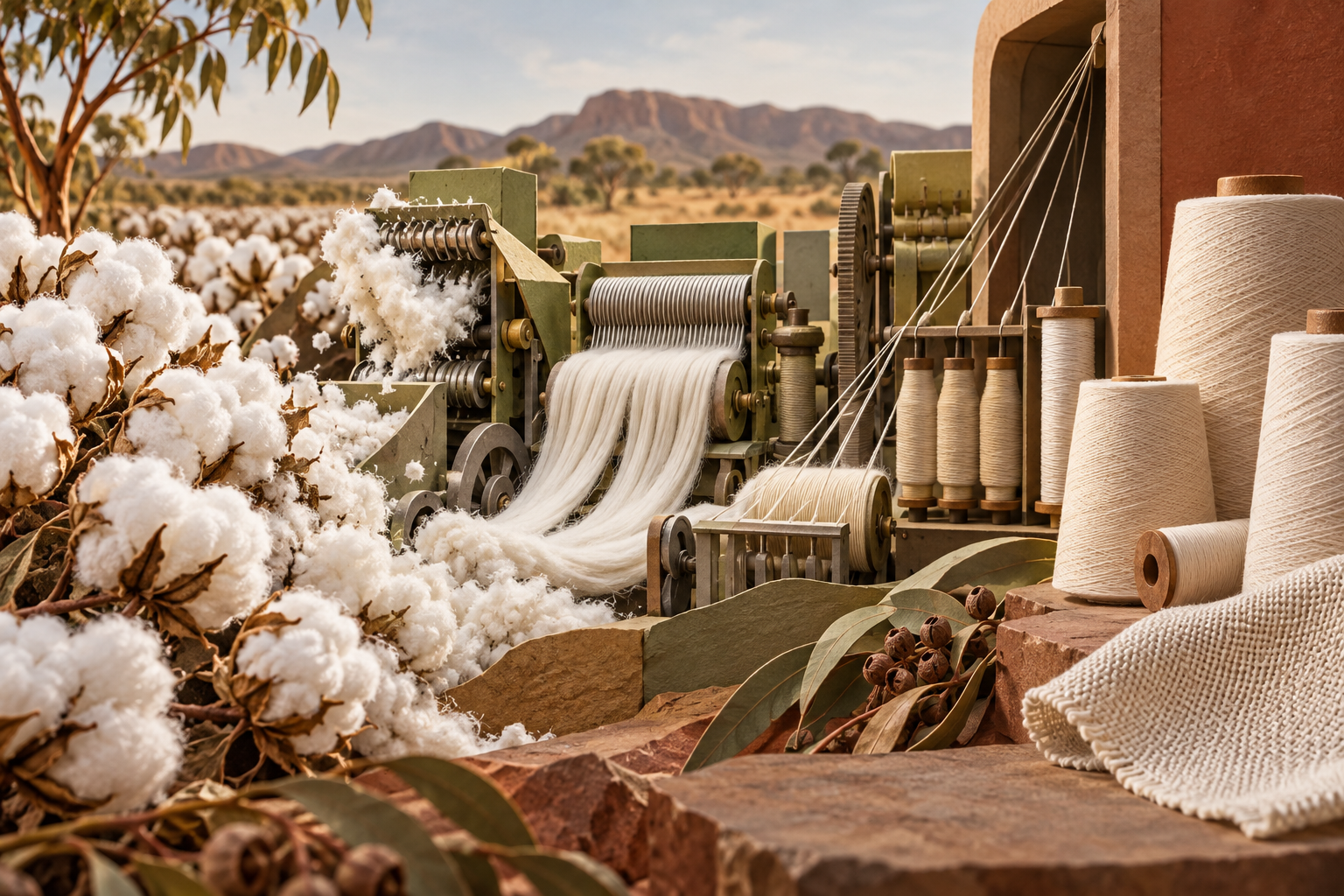
The missing industrial step sits between a bale of fibre and the yarn a textile maker can use. Rebuilding it takes more than buying a machine.
Capability gap established; investment case conditional
Growing cotton and turning it into yarn are different capabilities. A new feasibility blueprint asks whether industrial spinning can return, but a mill needs competitive operating costs and dependable buyers as well as Australian fibre.
Why Lens says this →Watch through Lens · Issue 006 · 8:37
Start with cotton at 2:10, then follow the rest of the episode. The reporting and sources stay on this page.
Choose how to read this
The facts do not change. Each view uses the same published sources and leaves the same questions open.
See through another Lens
Each view notices something useful. None is allowed to stand in for the complete evidence.
Maker
The yarn has to arrive at the quality and price I can use.
What this view explainsConnect the missing stage to a downstream buyer.
What it may missA single buyer may not provide enough demand for a mill.
The record
Cotton farming produces fibre. Ginning separates that fibre from seed and other material. Spinning prepares and draws fibres together into a continuous yarn. Weaving interlaces yarns; knitting forms loops. Garment production then cuts and joins fabric into clothes.
Owning the first stage does not supply the equipment, skills or customers for the next. CRDC's research brief identifies an absence of domestic cotton textile spinning capacity. This is a specific industrial gap, not evidence that Australians have stopped making textiles or clothes.
Cotton Australia: field to fashion ↗CRDC: viability of domestic cotton textile production ↗
See how it works
Grow cotton; separate fibre from seed.
A bale can be exported.
Prepare and draw fibre into yarn.
Missing domestic industrial cotton capabilityThe input a fabric maker needs.
Turn yarn into fabric.
Cut and sew the finished fabric.
The record
ABC Rural reported on 7 September that CSIRO scientist Stuart Gordon had produced a template companies could adapt into a more focused business case. The reported study concentrates on short-staple spinning, principally associated with cotton. It should not be presented as a ready-made answer for every part of the wool industry.
The CRDC commission asks for a techno-economic assessment of machinery, energy, recycled inputs, location and market demand. A research commission describes what should be investigated. The reported blueprint describes progress. Neither is a financed factory or a guarantee of profitability.
ABC Rural: spinning feasibility blueprint ↗CRDC: viability of domestic cotton textile production ↗
Lens analysis
The commissioning document points to labour, energy, older technology and scale in the historical loss of spinning. It also asks whether automation and different energy arrangements change the calculation now. The right comparison is therefore between actual modern configurations, not today's mill and a remembered factory from decades ago.
A useful commercial test would divide annual fixed costs by saleable yarn output, then add fibre, electricity, labour, maintenance, freight, finance and waste. Idle equipment spreads its fixed cost over fewer units. Cheap input fibre cannot rescue a mill whose utilisation, energy bill or product mix does not work.
This is Lens's explanation of the investment mechanism, not a cost estimate from the unavailable final model. We have not invented a plant price, workforce count or electricity threshold. Those numbers would need the machine specification, shift pattern, yarn quality, financing terms and buyer requirements.
CRDC: viability of domestic cotton textile production ↗AFC/R.M.Williams manufacturing strategy ↗
See how it works
Lower utilisation spreads the same fixed costs across fewer units. Dependable orders matter alongside machinery.
The record
The reported candidate locations are Toowoomba, Brisbane, Narrabri, Dubbo, Sydney and Melbourne. They are options examined, not announced construction sites.
The trade-off runs in both directions. A location can reduce the journey for raw fibre while increasing the distance to fabric makers or an export port. The useful map would combine inbound and outbound freight, power, workforce and customer access. The nearest cotton field does not automatically identify the cheapest delivered yarn.
Lens analysis
The Australian Fashion Council's March strategy argues for public procurement to help anchor demand, alongside skills and advanced machinery. That is an industry proposal. It does not establish that government orders are large, stable or suitably specified enough to keep a particular spinning line busy.
Buying a uniform from an Australian business is not the same proposition as requiring Australian-spun yarn. A contract could support local design, distribution or sewing while the fabric still contains yarn spun overseas. To test the proposal, trace the procurement specification through every production stage.
The Commonwealth rules retain value for money and include priorities for Australian businesses in some procurements. They do not themselves provide a mill with a yarn off-take agreement. Contract duration, volumes, quality, price review and verified origin would all matter before demand could support financing.
AFC/R.M.Williams manufacturing strategy ↗Commonwealth Procurement Rules ↗
Lens analysis
A credible next step would be a particular plant, with a particular product and buyers willing to purchase it under workable terms. A pilot might test process quality. A customer contract might test demand. A financing decision might test the combined business case. They answer different questions.
Keeping more processing in Australia could offer traceability and another supply option. It may also cost more. Whether that premium is worthwhile depends on the buyer's purpose and the risks it avoids; it is not settled by patriotic packaging.
The missing step is ordinary enough to overlook and consequential enough to shape the whole chain. The new opportunity is to test whether it can work now, with the actual costs and orders visible.
CRDC: viability of domestic cotton textile production ↗AFC/R.M.Williams manufacturing strategy ↗Commonwealth Procurement Rules ↗
ABC Rural reported CSIRO's business-case blueprint on 7 September; industry is asking for dependable demand.
Growing cotton and turning it into yarn are different capabilities. A new feasibility blueprint asks whether industrial spinning can return, but a mill needs competitive operating costs and dependable buyers as well as Australian fibre.
CRDC's commissioning document identifies the cotton-spinning gap and the factors a viable project must test.
Growing cotton and turning it into yarn are different capabilities. A new feasibility blueprint asks whether industrial spinning can return, but a mill needs competitive operating costs and dependable buyers as well as Australian fibre.
Australia retains textile and garment businesses. Missing industrial cotton spinning does not mean there is no Australian textile industry.
Cotton short-staple industrial spinning, with wool distinctions. The commissioned research scope and named-source report are available; the final commercial model is not independently audited.
AI-assisted research and writing. Evidence checked 2026-09-18.
Research commission scopes cotton spinning feasibility, cost, location, automation and energy. Proposed project Jan–June 2026; not final findings.
A1 · Published date not stated · Checked 2026-09-18Named CSIRO scientist describes adaptable business-case template, short-staple focus and six candidate locations. Full final model not retrieved.
B2 · Published 2026-09-07 · Checked 2026-09-18Industry strategy prioritises demand, skills and technology; evidence of an industry proposal, not established economic outcomes.
A1 · Published 2026-03-12 · Checked 2026-09-18Value for money and some Australian-business priorities; buying from an Australian business does not alone establish Australian fibre processing.
A1 · Published 2025-11-17 · Checked 2026-09-18Distinct fibre, ginning, spinning, textile and garment stages.
A2 · Published date not stated · Checked 2026-09-18Possible effects · We cannot say how likely
It could give investors, regions and buyers a testable path toward domestic yarn production, but fibre supply alone does not establish a competitive mill, dependable demand or Australian-made garments.
Industry and research bodies commissioned feasibility work covering mill economics, technology, energy, location and demand while a manufacturing strategy called for coordinated buyers and capability.
A credible model plus committed buyers could move discussion from general reshoring ambition to site, finance and procurement decisions.
Where the connection stopsThe records establish feasibility work and industry proposals, not a completed business case, financed mill or measured economic outcome.
How people may respond
How a feasibility blueprint is interpreted could change buyer, investor and regional attention before a mill is financed.
What the evidence does not showFeasibility work is established; bankability, committed demand and construction are not.
The study is presented around technology, energy, location, demand and procurement conditions.
Buyers and investors may see a concrete set of decisions rather than a general reshoring ambition.
Attention moves to disclosed economics and demand commitments.
Manufacturers, buyers, regions and financiers: Test sites, contracts, finance and operating assumptions.
A project could move from study to committed investment.
What we know has changedWe have not established that this possible change has happened.
What this does not showSerious evaluation does not establish that the mill is competitive or will proceed.
This is the first time Lens has mapped this path. We have no later evidence showing whether it is happening more, less or about the same.
A national feasibility project can sound like project momentum.
Public or regional expectations may advance ahead of demand and capital.
Attention may focus on location and jobs before bankability is shown.
Regions, industry and policymakers: Promote or plan around a project that remains conditional.
The study can remain useful while no investment commits.
What we know has changedWe have not established that this possible change has happened.
What this does not showFailure to build would not make the feasibility work valueless.
This is the first time Lens has mapped this path. We have no later evidence showing whether it is happening more, less or about the same.
If the feasibility model identifies a competitive configuration and dependable buyers make credible commitments
Then a project could progress to location, approvals, finance, equipment and workforce planning.
Would weaken this: Operating costs remain uncompetitive under disclosed assumptions. Demand commitments cover fibre origin but not Australian spinning.
Scope: Industrial cotton spinning, not the complete garment supply chain. Horizon: The post-feasibility investment and procurement cycle.
If the model is useful but no project secures sufficient demand, capital or operating advantage
Then regions and firms could still use it to identify missing conditions without a domestic mill being built.
Would weaken this: A funded project reaches procurement or construction. Policy or technology materially changes the cost model.
Scope: The evidentiary value of the feasibility work. Horizon: After publication of the final blueprint.
Research commission scopes cotton spinning feasibility, cost, location, automation and energy. Proposed project Jan–June 2026; not final findings.
Open evidence ↗Named CSIRO scientist describes adaptable business-case template, short-staple focus and six candidate locations. Full final model not retrieved.
Open evidence ↗Industry strategy prioritises demand, skills and technology; evidence of an industry proposal, not established economic outcomes.
Open evidence ↗Value for money and some Australian-business priorities; buying from an Australian business does not alone establish Australian fibre processing.
Open evidence ↗What could change this assessment?
Free Lens updates
Our free weekly email brings you the latest Lens reporting and what changed.