Issue 002 · Story 1 · Technology and powerOne story. Many lenses.
Same evidence. Different perspective.
Viewing through
Whole story
Start with the shortest supported answer, then follow the evidence and the limits together.
What comes into focusIt keeps the claim, its source and the point where certainty ends in one view.
What this view may missA specialist Lens can make one practical consequence easier to see.
Changing the Lens changes what comes into focus. It never changes the evidence underneath.
Issue 002 Story 1 · Technology & power
Australia wants AI data centres to bring new power. Is that actually a rule?
The government first set national expectations, then promised to turn them into mandatory standards and legislation. The direction is clearer than it was—but the future law, tests and sanctions do not yet exist in the admitted record.
By Lens with Sense EnginePublished 15 August · Updated 16 August 2026About seven minutes
Update · 16 August 2026
Lens admitted a 15 July Prime Ministerial announcement that materially strengthens the future pathway. The March expectations are not themselves a uniform law; the government now says it intends to legislate mandatory national standards, including a legal obligation for new large data centres to underwrite power supply. No legislation or compliance test was available in the admitted records.
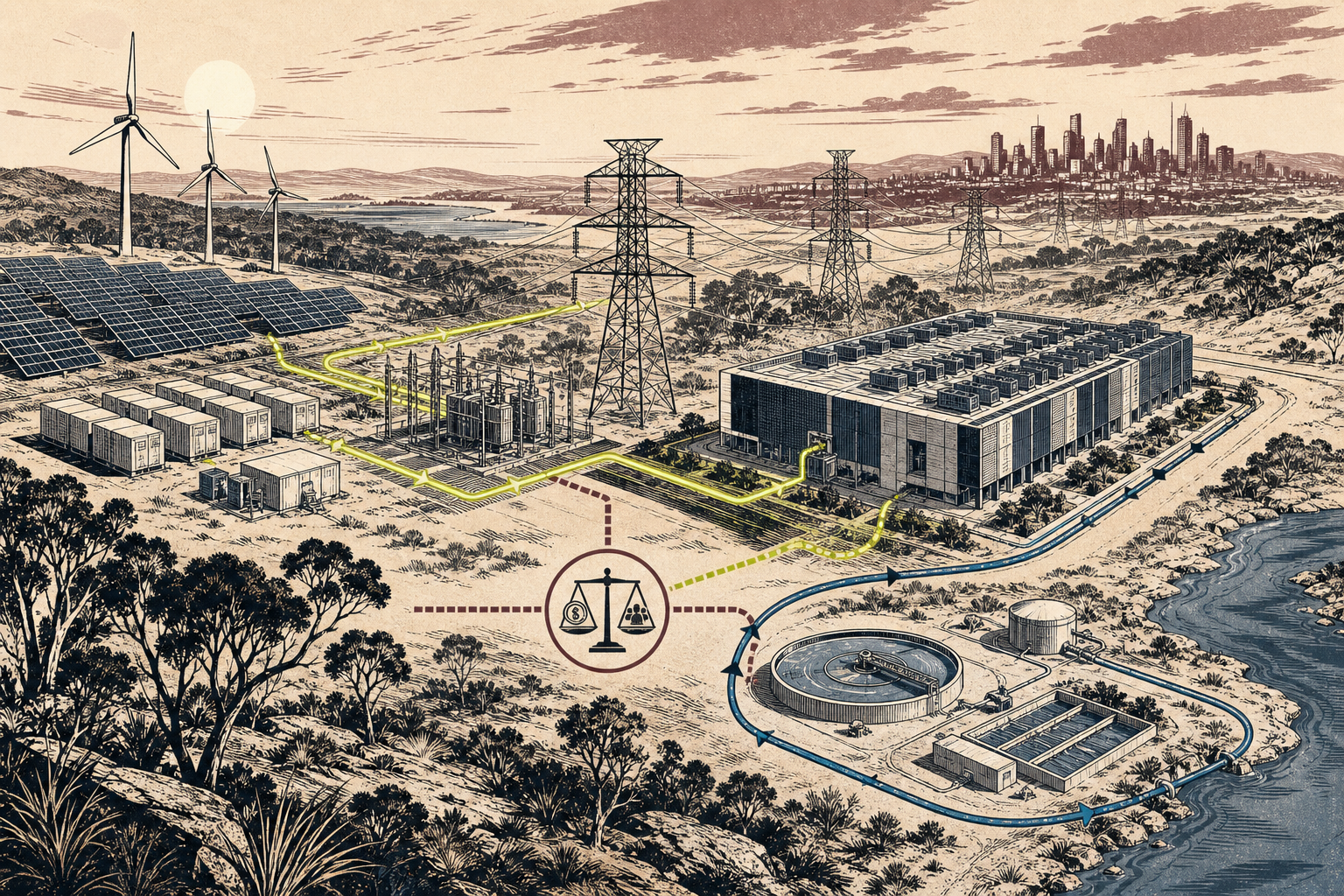
Power supply, grid connection, flexible demand and water are connected—but they are not the same obligation. Original AI-assisted Lens illustration.
Watch the relevant chapter from Lens in 8, then inspect the evidence below.
What people heard
AI data centres have been told to bring their own power, so that must already be the law.
Partly established
Is it actually an enforceable rule?
Short answer. Current expectations can affect assessment priority. A mandatory national regime has been announced, but its legislation, tests and sanctions are not yet in the admitted record.
Choose how to read this
Read, listen or follow the question.
The facts do not change. Each view uses the same published sources and leaves the same questions open.
◫Different viewsSee what each perspective notices—and may miss.
See through another Lens
Which view do you want to understand first?
Each view notices something useful. None is allowed to stand in for the complete evidence.
Grid planner
Large new loads must be assessed as part of a shared electricity system, not as isolated buildings.
What this view explainsWhy supply, storage, connection costs and flexible demand appear together.
What it may missA system forecast cannot establish the obligation imposed on one project.
The answer
Not yet. Today’s expectations affect assessment priority; the government has promised a uniform mandatory regime next.
01
What exists
The Commonwealth says aligned proposals will be prioritised in its regulatory assessments. Energy-intensive proposals that do not align will not receive that priority.
02
What it expects
New projects should add clean supply or storage, pay their network costs, use power flexibly and minimise water use.
03
What comes next
The government says national standards will become mandatory and be legislated. National Cabinet agreement, legislative text, tests and sanctions remain unfinished.
At the end of March, the Australian Energy Market Operator counted 11 large data-centre projects moving through the transmission connection process. Together their eventual maximum demand was 5.4 gigawatts. Most were still at an early stage, so that is a pipeline—not electricity being consumed today.
AEMO says data centres currently use about 2 per cent of Australia's grid-supplied electricity. Its earlier central scenario put them near 6 per cent by 2030. The exact path remains uncertain, but the direction is large enough that supply, transmission and connection decisions must be made before every server hall arrives.
The honest question is therefore not whether a data centre uses electricity. It is who adds the supply, who pays for the network and whether a large flexible user helps or strains the grid.
Four obligations are being compressed into one slogan.
The official expectation uses several mechanisms. None alone proves that a project has neutralised its effect on the grid.
01
Add supply or storage
Secure new and additional clean generation or storage to offset the project's demand. When onsite generation is impractical, official guidance recognises offsite power-purchase agreements as one possible path.
02
Pay connection costs
Cover the project's share of new transmission and distribution infrastructure rather than shifting those direct connection costs to other users.
03
Move demand
Use flexibility and peak-load management so computing demand can respond when the grid is strained or abundant supply is available.
04
Use less
Adopt efficient technology and disclose consumption data. New supply is not permission to waste electricity.
Current expectation versus promised law
The March expectation permits new generation or storage and official guidance recognises offsite supply agreements. In July the Prime Minister promised a legal obligation for the next generation of large data centres to underwrite new power and put at least as much energy into the grid as they take out. The legislation and universal quantitative test have not yet been published.
“Use water responsibly” does not mean “use no water.”
The expectation asks projects to minimise water use, choose secure sources suited to local conditions, use efficient cooling, consider non-potable and circular water, cover infrastructure costs and report transparently.
That makes the local question more important than a national average: what source will this project use, during drought, in this catchment, and what other users depend on it?
Two government processes answer different questions.
A technical connection standard is not the same thing as a policy about who supplies energy or pays for infrastructure.
National expectations
Does the development serve Australia's interests?
Energy supply, network costs, water, jobs, security, research capability and community benefit. Alignment affects Commonwealth assessment priority and is intended to flow into other approval processes.
Draft grid standards
Will the connected equipment behave safely?
The AEMC's separate draft addresses how large inverter-based loads respond to voltage and frequency disturbances, recover demand and maintain compliance with connection performance standards.
A political commitment is evidence of direction—not evidence that a law has commenced.
On 15 July the government said the future standards would make the data-centre requirements mandatory, national and consistent, with legislation expected early in 2027. It also established an Office of AI to accelerate the work.
That is where the public evidence stops. The bill, legal mechanism, compliance formula, transition rules and penalties have not yet been published.
The expectations are clearer than the enforcement.
What National Cabinet agrees and what the promised legislation actually contains
What quantitative tests will establish sufficient additional power, demand flexibility or water efficiency
What sanctions and transitional arrangements will apply under the future standards
Whether any named proposed or operating data centre satisfies the expectations
Whether the eventual arrangements will prevent upward pressure on a particular household's electricity bill
What the final AEMC technical connection rule will require and when each provision will commence
Thread from Issue 001
The household electricity question continues here—but the causal bridge is still missing.
Connected · not proven as a cause
Issue 001 explained what Queensland's regulated benchmark could and could not say about one household bill. Large proposed data centres matter to power-system planning, but the available evidence does not show that they increased any particular household bill.
Official policy establishes the expectations. AEMO establishes the connection pipeline. The AEMC establishes the status of its separate technical rule process.
Established
The Australian Government published five national expectations for new and expanded large data centres and AI infrastructure on 23 March 2026.
The Commonwealth says proposals most closely aligned with the expectations will be prioritised, while energy-intensive proposals not closely aligned will not be prioritised in Commonwealth regulatory assessments.
New projects are expected to secure new and additional clean generation or storage to offset demand, cover their share of network costs, improve efficiency and support grid flexibility.
Projects are expected to minimise water use, choose secure sources suited to local conditions, cover relevant infrastructure costs and report transparently on water use and efficiency.
The Commonwealth says it is working with states, territories, regulators, suppliers and market bodies to implement the expectations through existing approval and energy-market processes.
AEMO reported 11 large projects representing 5.4 GW of maximum demand in the transmission connection process at the end of March 2026, with most projects still at an early stage.
The AEMC published draft technical connection standards in March 2026 for large inverter-based loads such as data centres. Those proposals address grid disturbance and connection performance, not the separate requirement to add energy supply.
Official energy guidance identifies offsite power purchase agreements as a viable way for energy-dense data centres to invest in low-carbon supply when onsite generation is impractical.
On 15 July 2026 the government announced its intention to legislate mandatory national AI standards, including a legal obligation for the next generation of large data centres to underwrite new power supply, pay their grid-connection share, reduce demand when needed and minimise water use.
The admitted records do not contain enacted national standards, legislative text, common quantitative thresholds, sanctions for non-compliance or evidence establishing the compliance of any named project.
Lens assessment
Lens assessment
How we checked it Read the reporting notes
The question
Distinguish the government's stated expectations from enforceable obligations, and understand what the energy and water expectations require in practical terms.
What we checked
Australian Government, AEMO and AEMC records available through 16 August 2026. Project-specific state approvals, commercial energy contracts, the outcome of the announced National Cabinet process and later legislation or market rules are outside the established boundary unless separately admitted.
Best-supported answer
The Commonwealth's March expectations operate now through assessment priority and existing approval processes. In July, the government announced that it intends to replace that distributed approach with mandatory national standards and legislation, including a legal obligation for the next generation of large data centres to underwrite new power. That future regime is a stated government commitment, not yet an enacted uniform data-centre law; its text, tests and sanctions remain unresolved.
Why we told it this way
The records support a mechanism-first explanation of what each expectation means and a clear separation between present policy, future implementation and project-level unknowns. They do not yet support a compliance ranking or a claim about household bill outcomes.
prominence
Lead with the distinction between the current expectations, the announced future mandatory framework and enacted law.
The March expectations operate through prioritisation and existing processes; the July announcement promises national legislation but does not itself enact it.
grouping
Group the energy expectation into additional supply, network costs, efficiency and flexible demand.
Those four mechanisms are expressly separated in the official expectation and should not be collapsed into the misleading phrase 'generate all of its own power'.
separation
Explain water location, source, infrastructure cost, resilience and reporting separately from electricity supply.
The water expectation has a different resource, local boundary and implementation pathway from the energy expectation.
empty region
Do not rank companies, forecast household bills, describe the announced standards as already enacted or declare the policy successful.
No admitted legislation, project-level compliance record, common metric or demonstrated consumer-price outcome supports those conclusions.
Human responsibility remains. Sense preserved the distinction between current policy expectations, announced future legislation, technical connection rules and project-level compliance. Lens remains responsible for the published wording, source admission and corrections. The requested form never overrules the evidence.
Issue 002 record Seven official records reviewed · Sense run opened before drafting · current expectations, promised legislation, technical rules and project compliance kept separate · published 15 August · updated 16 August 2026
Keep this in Focus
Know when the rules or evidence change.
Follow the evolving evidence about AI data centres, electricity, water and the promised national rules.
Material changes only. Email updates can be stopped at any time.
Possible effects · We cannot say how likely
What this could change
They could shift some power, grid and water costs onto new large projects and affect which proposals proceed first, but the admitted record does not yet contain the promised uniform law, tests or sanctions.
Documented action
The Commonwealth published expectations, linked alignment to assessment priority and announced an intention to legislate mandatory national standards for new large data centres.
What Lens thinks may follow
If enforceable obligations follow, project design and location decisions could change because developers would need to account for new supply, grid connection, flexible demand and water requirements earlier.
Where the connection stopsThe records establish expectations, a prioritisation statement, draft technical work and a legislative intention—not enacted uniform duties or compliance by any named project.
What this depends on—and other possibilities
This depends on
The promised legislation translates the expectations into measurable obligations.
Approvals, connection processes and enforcement use compatible definitions.
Other explanations
Existing market and connection constraints may drive similar project changes without new legislation.
Standards may permit multiple compliance paths with materially different system effects.
How different interpretations could affect what happens next
How people may respond
How the story itself could change what happens
How readers and developers interpret the government's expectations could affect project design before the promised national rules exist.
What the evidence does not showThe records establish expectations and a promised legal regime, not how widely either has changed investment behaviour.
One possible path
A promise is treated as a coming operating rule
Not enough evidence yet
How it is told
Government language emphasises future mandatory national standards.
What people may take from it
Developers and financiers may read the announcement as a signal to design for new-power and water expectations now.
Where attention could turn
Attention shifts from whether a rule exists to how projects can satisfy the expected standard.
What people may do
Developers, financiers and planners: Bring forward power, storage, water and network decisions.
What could change
Project design and contracting begin to reflect the anticipated regime before enactment.
What we know has changedWe have not established that this possible change has happened.
What this does not showPreparatory behaviour would not prove that the final law has the same tests or that every project complies.
Why we are cautious
Why we cannot tell yet
This is the first time Lens has mapped this path. We have no later evidence showing whether it is happening more, less or about the same.
Signs that would support this path
Introduced legislation with thresholds, responsible regulators, compliance tests and consequences for failure.
Signs that would weaken it
The final law lacks measurable duties or enforcement.
Material project classes are exempted without an equivalent mechanism.
This depends on
The promised legislation translates the expectations into measurable obligations.
Approvals, connection processes and enforcement use compatible definitions.
One possible path
The announcement is treated as aspiration
Not enough evidence yet
How it is told
The current mechanism relies on expectations, prioritisation and existing approvals.
What people may take from it
Actors may regard the policy as negotiable until legislation, tests and sanctions are published.
Where attention could turn
Attention remains on approvals and commercial terms rather than one national compliance standard.
What people may do
Developers and regulators: Continue project-by-project decisions under existing mechanisms.
What could change
The practical effect stays uneven until the legal regime becomes concrete.
What we know has changedWe have not established that this possible change has happened.
What this does not showUneven behaviour would not show that the expectations have no influence.
Why we are cautious
Why we cannot tell yet
This is the first time Lens has mapped this path. We have no later evidence showing whether it is happening more, less or about the same.
Signs that would support this path
Projects are assessed under existing processes without a final national statutory test.
Signs that would weaken it
A binding national regime commences.
States adopt equivalent common standards with transparent enforcement.
This depends on
The promised legislation translates the expectations into measurable obligations.
Approvals, connection processes and enforcement use compatible definitions.
Two ways this could develop
This depends on what happens next
Mandatory standards reshape proposals
If legislation and implementing rules create measurable obligations for new large projects and agencies enforce them consistently
Then developers could bring forward generation, storage, connection and water plans, while proposals unable to meet the tests could change, move or slow.
What to watch—and what would weaken it
Introduced legislation with thresholds, responsible regulators, compliance tests and consequences for failure.Federal legislation, explanatory material and final energy-market rules.
Would weaken this: The final law lacks measurable duties or enforcement. Material project classes are exempted without an equivalent mechanism.
Scope: New or expanded large data-centre projects covered by the future regime. Horizon: The legislative and rule-making cycle; no commencement date is established here.
This depends on what happens next
Expectations remain the main lever
If uniform legislation is delayed or leaves most implementation to existing approvals and connection processes
Then outcomes could vary by jurisdiction and project, with prioritisation and network negotiations doing more work than a common national compliance rule.
What to watch—and what would weaken it
Projects are assessed under existing processes without a final national statutory test.Planning approvals, connection determinations and government implementation updates.
Would weaken this: A binding national regime commences. States adopt equivalent common standards with transparent enforcement.
Scope: Commonwealth expectations and existing state, planning and energy-market processes. Horizon: Until legislation or final rules replace the current pathway.
How do we know?Inspect the evidence and its limits
Evidence used in this assessment
Department of Industry, Science and Resources · date unknownExpectations for data-centre and AI infrastructure developers
The Australian Government published five national expectations for new and expanded large data centres and AI infrastructure on 23 March 2026.
Open evidence ↗Australian Energy Market Operator · date unknownAEMO digital-demand connection update
AEMO reported 11 large projects representing 5.4 GW of maximum demand in the transmission connection process at the end of March 2026, with most projects still at an early stage.
Open evidence ↗Australian Energy Market Commission · date unknownDraft grid standards for large data-centre connections
The AEMC published draft technical connection standards in March 2026 for large inverter-based loads such as data centres. Those proposals address grid disturbance and connection performance, not the separate requirement to add energy supply.
Open evidence ↗Prime Minister of Australia · date unknownAnnouncement of intended mandatory national AI standards
On 15 July 2026 the government announced its intention to legislate mandatory national AI standards, including a legal obligation for the next generation of large data centres to underwrite new power supply, pay their grid-connection share, reduce demand when needed and minimise water use.